Title here
Summary here


A detailed comparison of Zynq-7000 System-on-Modules and their benefits for product development.
May 18, 20156 minutes

In the last year or so, there has been an explosion in the availability of System-on-Modules (SoMs) featuring the popular FPGA+ARM combo Zynq-7000 SoC from Xilinx. I’ve always promoted the idea that FPGAs and SoCs allow for faster design cycles and rapid proof-of-concept, but these SoMs take that advantage to another level. Let me explain why. In the past, I would handle most projects by doing a proof-of-concept on an evaluation board, then designing a custom board that integrates all the required components onto a single PCB. While this process is fairly straightforward and minimizes my risk in designing the final custom board, it still has its drawbacks:
My last point is the most important one because most companies these days want a proof-of-concept or a prototype that can be tested in the field or in their product enclosure. This usually isn’t possible with eval boards, but it often is with SoMs. The major advantage that SoMs have over eval boards is that they can be used to develop prototypes that are appropriate for the environment/enclosure in which they will be used. On top of that, some SoMs are manufactured in large quantities, have a good supply from reliable companies and can be seriously considered for use in the final product.
Here are some of the benefits of the SoMs when compared to evaluation and development boards:
So let me describe a typical design experience with a SoM. My client wants an image processor with 16 image sensors connected to the Zynq-7000. I propose a Zynq SoM so that I can leverage all the work that has gone into the board design, plus kickstart the FPGA design with the provided code examples. I design a custom carrier for the SoM with 16 image sensors - the PCB is only 4-layers and is trivial because I don’t have to route an FPGA or DDR3 memory. In a short time, we have a working prototype that fits nicely into the product enclosure and the client can start putting it in front of customers. Going from here to the final product can take many paths, but the important thing is that my client now has something that is presentable to the market, and he got there with a minimum of delay and expense.
Here is my take on a few of the Zynq-7000 SoMs on the market at present.
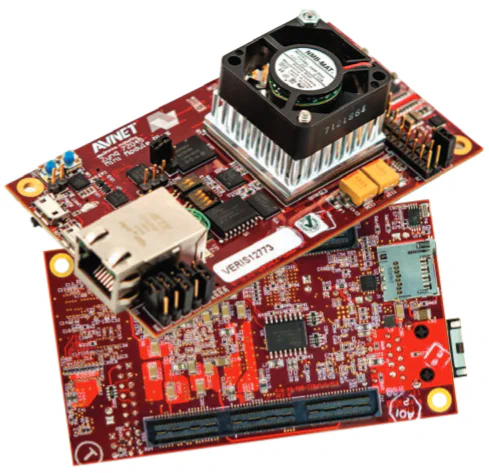
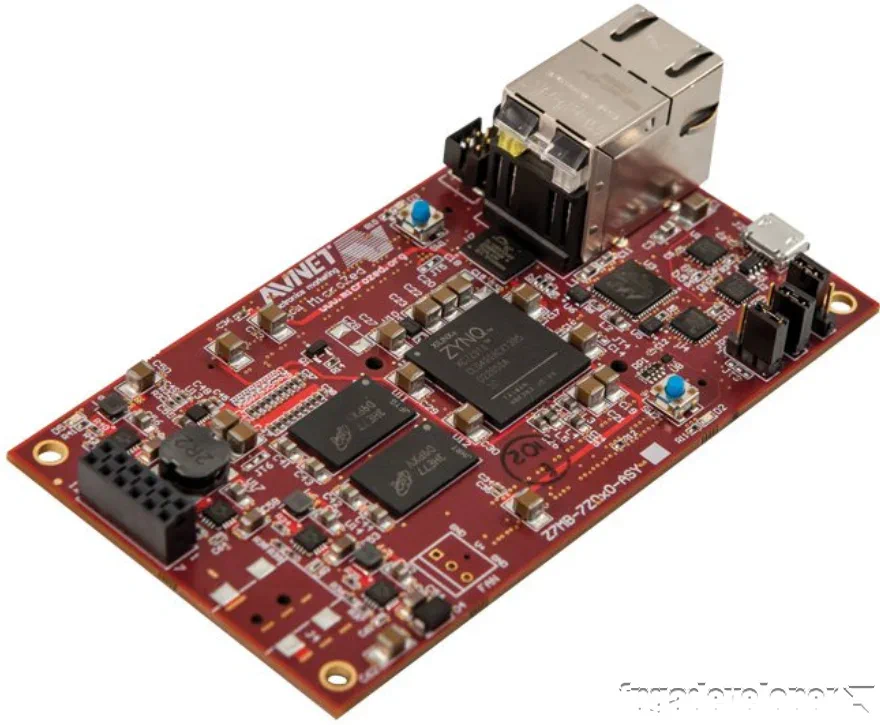
Arguably the most popular Zynq SoM due to its affordability and being one of the first on the market in this space, the MicroZed from Avnet is a versatile SoM, great for integration into custom designs, but also can be useful as a stand-alone development board.
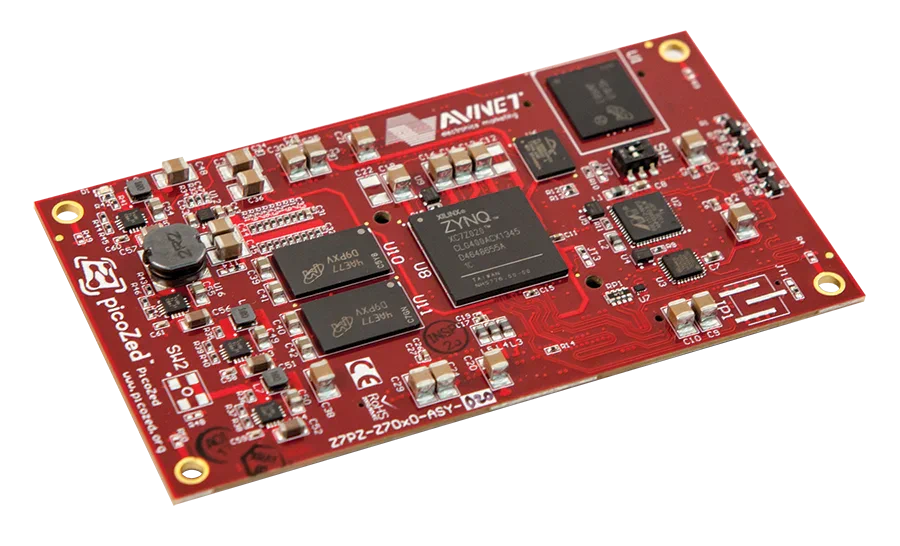
Designed for better integration into custom designs, the PicoZed from Avnet is similar to their MicroZed product but they’ve basically pushed all the interfaces through the expansion connectors so that you only use what you need. This reduces the cost of the SoM and relaxes the mechanical constraints on your design because you choose where to put the bulky connectors. There is also a version of the PicoZed with gigabit transceivers.
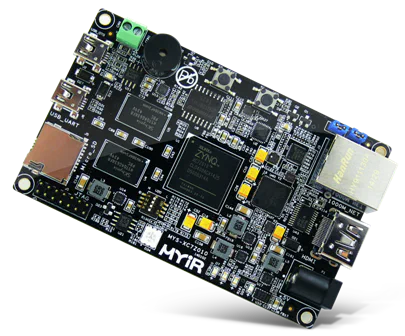
Although similar in appearance to the MicroZed, the Z-Turn from MYIR differentiates itself with a few different features. A HDMI interface makes it interesting as a single board computer, while the onboard accelerometer could be useful for mobile applications or IoT devices.
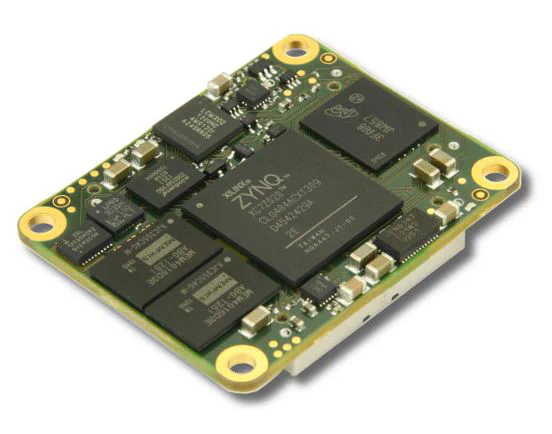
Maybe the smallest Zynq SoM on the market, the TE0720 from Trenz Electronic delivers a lot of features for your real-estate and would be great for especially rugged applications.
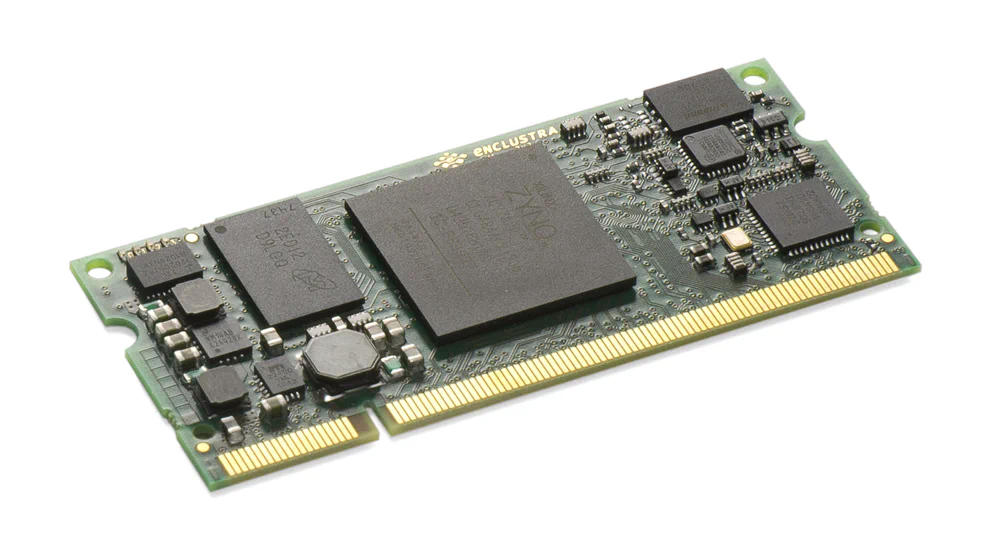
A really innovative concept from Enclustra, designed into a SODIMM form factor, the Mars ZX3 offers 108 I/Os in a small but mainstream package.
Xilinx Zynq-7020 AP SoC in the CLG484 package (XC7Z020)
ARM® dual-core Cortex™-A9
Xilinx Artix™-7 28 nm FPGA fabric
SO-DIMM form factor (67.6 x 30 mm, 200 pins)
108 user I/Os
Gigabit Ethernet and USB 2.0 OTG PHYs
Up to 1 GB DDR3 SDRAM
512 MB NAND flash
16 MB quad SPI flash
Single 3.3 V supply voltage
The only Zynq SoM on the market that carries the largest in the Zynq-7000 family, the Zynq MMP from Avnet is loaded with either the XC7Z045-1FFG900 or the XC7Z100-2FFG900. The Zynq MMP targets applications that require a great amount of FPGA resources or up to 8 gigabit transceivers.