Camera FMC: Connecting MIPI cameras to FPGAs
Camera FMC: Connecting MIPI cameras to FPGAs
FPGAs and MPSoCs are ideally suited for machine vision applications due to their ability to process large amounts of data in parallel and at high speeds. FPGAs can run highly power efficient neural network implementations and benefit from ultra low latency connections to multiple image sensors. Given the inherent strengths of FPGAs for machine vision, it surprises me that GPUs have become the dominant hardware platform for deep learning applications1 in recent years. In my opinion, most of the potential for FPGAs in machine vision remains to be exploited.

[Read More]

A peek at the new RPi Camera FMC

A peek at the new RPi Camera FMC

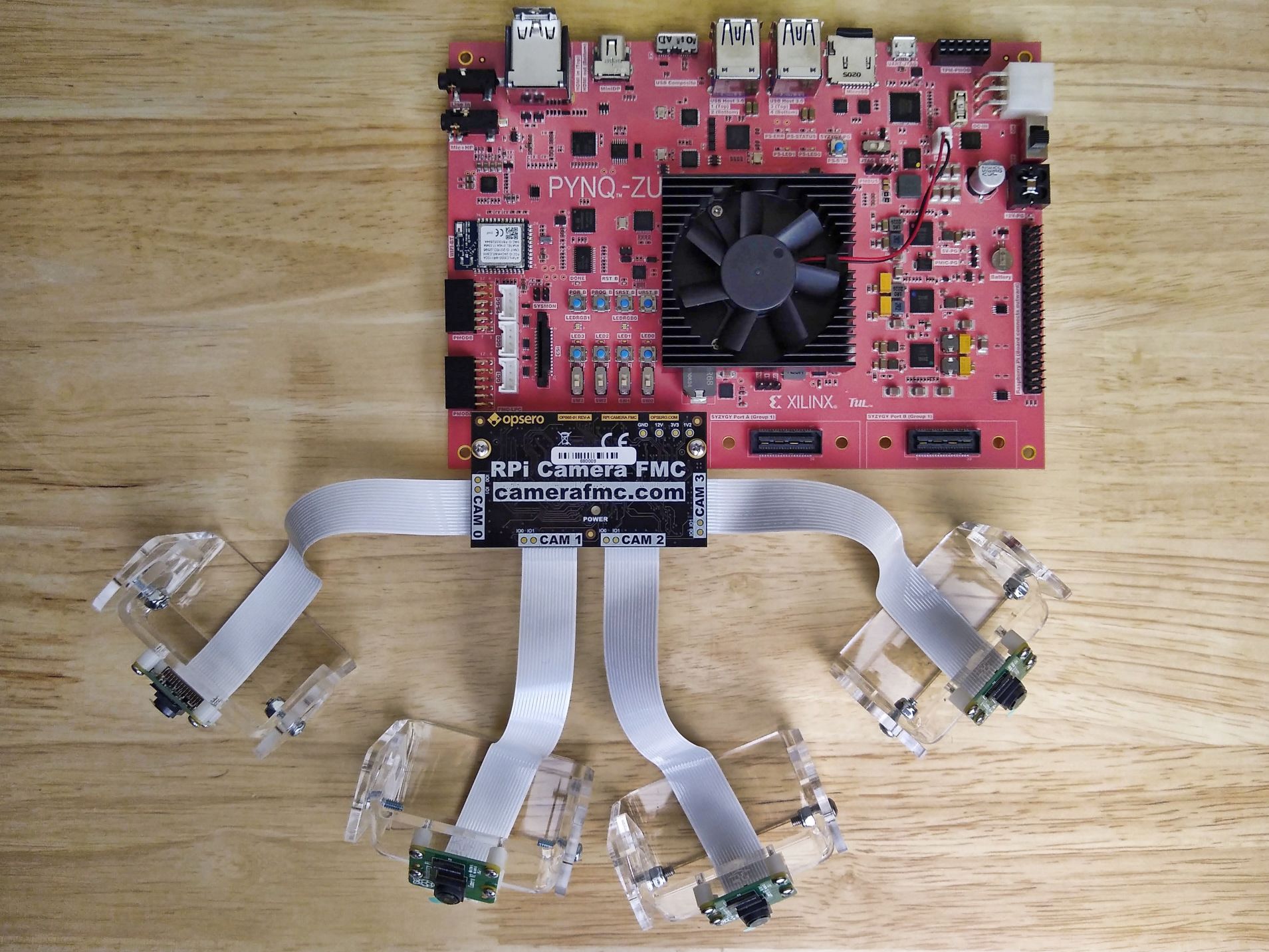
In the coming weeks we’ll be launching a new product called the RPi Camera FMC. This compact little FMC card allows you to connect 4x Raspberry Pi cameras (and variants) to a few Zynq UltraScale+ MPSoC boards listed below. All of the boards will support 4 cameras through the same FMC card.

I like Raspberry Pi and especially the impressive camera ecosystem that they and the RPi community have built up. These cameras are low cost, they come in many different types and levels of performance, and they have robust software support. Why aren’t we more actively employing this immensely valuable camera ecosystem in the FPGA space? Well the answer is complicated, but today I just want to share that my team and I are currently working on solutions to address this problem, and part of that is this new little board.

[Read More]

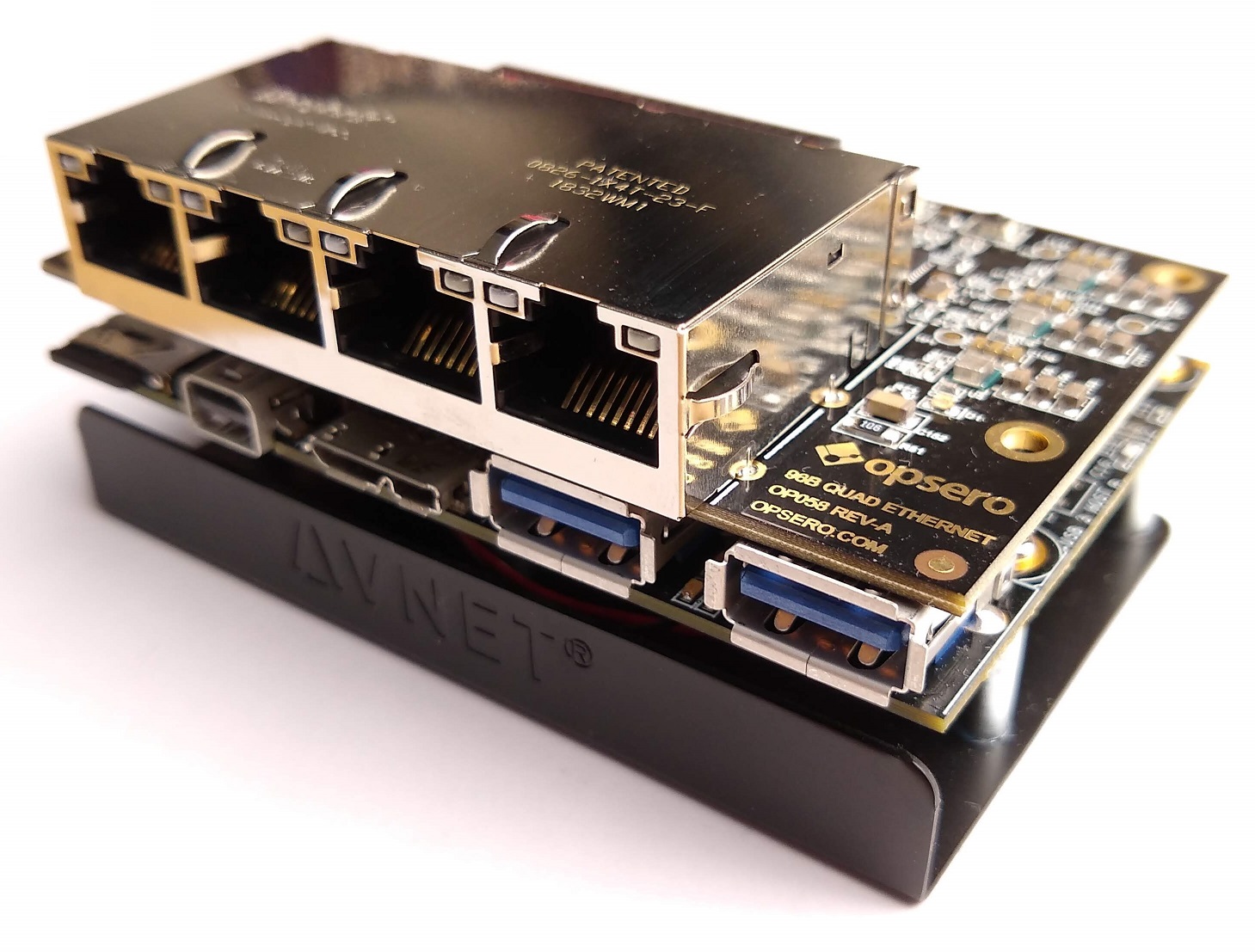
Introducing 96B Quad Ethernet Mezzanine

Introducing 96B Quad Ethernet Mezzanine

Update 2019-06-10: This product is now available to purchase! Read the documentation here, and get it from the order page here.

Over the last few months I’ve been really busy working on a new product and I just want to take a step back today and share some of it. Let me start with what it is and then I’ll tell you about how and why I did it.

The product

A 4-port Gigabit Ethernet mezzanine card designed for Avnet’s Ultra96 Zynq Ultrascale+ single board computer.

[Read More]

Board bring-up: MYIR MYD-Y7Z010 Dev board

In this tutorial video, I bring-up the 3x Gigabit Ethernet ports on the MYD-Y7Z010 Development board from MYIR. Firstly, I create a Vivado design for this board, then I export it into the SDK and generate the echo server application for each of the 3 ports (note that the echo server application only supports one port at a time). At the end of the video, I test each of these designs on hardware and ensure that the ports are given an IP address via DHCP and that I can ping the port. I did this on the MYIR dev board but I hope that the tutorial can be of help to people bringing up Ethernet ports on other platforms or their own custom boards.

[Read More]
lwip  myir  zynq 

Avnet Silica's industrial networking demo features Ethernet FMC

Avnet Silica was at Embedded World 2018 in Nuremburg, Germany last February demonstrating some cool industrial networking solutions such as TSN and FOSS GNU/Linux security concepts on Opsero’s Robust Ethernet FMC and the Zynq UltraScale+. Get a glimpse of the hardware at 0:54. If you saw the demo in person, I’d love to know what you thought of it.

IntelliProp Demos NVMe Host Accelerator on FPGA Drive

Early this year IntelliProp released a demo video of their NVMe Host Accelerator IP core running on the Intel Arria 10 GX FPGA Development board. As you can see in the video, they are using Opsero’s FPGA Drive product with the PCIe slot connector to interface the NVMe SSD to the FPGA board. They measured an impressive performance of around 2300MBps sequential write speed and 3200MBps sequential read speed. The FPGA Drive adapter was designed to fully handle Gen3 speeds precisely because these high throughputs are only possible with a Gen3 interface (note that M.2 SSDs have a 4-lane PCIe interface).

nvme 

Artix-7 Arty Base Project

Here’s a base project for the Arty board based on the Artix-7 FPGA. The Arty is a nice little dev board because it’s low cost ($99 USD) but it’s still got enough power and connectivity to make it very useful. I really like the fact that the JTAG and UART are both accessed through the same USB connector, so I only need to connect one USB cable. I also like the fact that I can power it from the USB connector alone - provided I don’t connect too many power hungry PMods or an Arduino shield.

[Read More]

Quick look at the UltraZed-EG SoM

In this video I take a look at the features of the UltraZed-EG System-on-Module and the Zynq UltraScale+ MPSoC. As is typical for Avnet products, it’s a great deal with a price tag of only $485 USD, when the device alone (XCZU3EG-1SFVA625E) would cost you $354 USD. This SoM can’t be used as an SBC (single board computer), it needs a carrier card such as the UltraZed PCIe Carrier Card; this board will cost you $499 USD and has most of the hardware you need to exploit the Zynq UltraScale+ device to its full potential: Gigabit Ethernet, Display Port, PCIe, USB3 and SATA among others. And of course, all of these peripherals are routed through to the PS (hardened IP) of the ZU+, so you don’t need to use up any programmable logic to take advantage of them - so all of your FPGA can be dedicated to the implementation of your ’edge’, or whatever it is that makes your product better/faster/leaner than the competition’s.

[Read More]
zynqmp